A Practical Guide to Migrating LLMs in Production RAG Systems
Published · Last updated · 8 min read
When running a production Retrieval-Augmented Generation (RAG) assistant for an engineering platform—answering developer questions across microservice architecture docs, incident runbooks, and API specs—model lifecycle management eventually catches up with you.
With the GPT-4 series models (including GPT-4o) approaching upcoming deprecation and sunset schedules, migrating to next-generation models like GPT-5.6 and GPT-5.6-mini became a mandatory operational milestone rather than an optional upgrade.
On paper, migrating to a newer, fundamentally more capable frontier model sounded straightforward. In our orchestration config, updating the deployment target took less than a minute:
# Before
MODEL_NAME = "gpt-4o"

# After
MODEL_NAME = "gpt-5.6-mini"
Then our engineers tested it in staging, and our integration test suites began reporting subtle regressions.
Upgrading to a superior model did not automatically make our RAG system better. Instead, the new model’s stronger reasoning priors and tighter alignment introduced unexpected behavioral shifts: over-reasoning on simple queries, false refusals on slightly informal runbooks, and schema parsing failures.
Here is what broke, why migrating to next-generation models is not a drop-in replacement, and the step-by-step playbook I gathered while leading the migration.
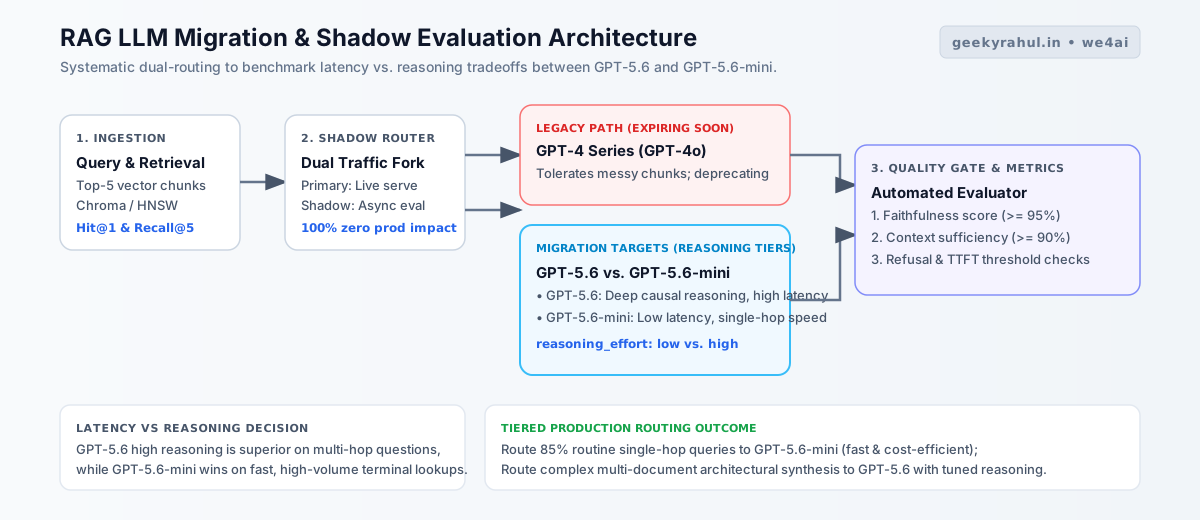 Figure 1: Dual-path shadow evaluation pipeline benchmarking latency and reasoning tradeoffs between GPT-5.6 and GPT-5.6-mini (Watermark: geekyrahul.in • we4ai).
Why upgrading to a “smarter” model breaks RAG
When a RAG system has been in production with GPT-4o for months, your system prompts, chunking strategies, and retrieval filters are subtly tuned to that specific model’s idiosyncrasies.
When you switch to a more advanced reasoning model like GPT-5 or GPT-5.6, three core differences surface immediately:
1. Over-thinking and false refusals
GPT-4o was relatively forgiving. If an internal runbook stated “restart service if latency spikes”, GPT-4o comfortably inferred how to format the operational step.
Next-generation models, equipped with deeper reasoning and stricter safety/grounding guardrails, can become overly pedantic:
“The documentation mentions restarting the service upon latency spikes, but it does not explicitly define the threshold for a spike or provide the exact CLI flag. Therefore, I cannot verify the command.”
The model was technically correct, but practically unhelpful. Factual adherence turned into premature refusals on everyday developer queries.
2. Verbosity drift and TTFT spikes
Deeper reasoning models tend to generate longer synthetic explanations or internal reasoning steps. On an interactive developer terminal or Slack bot, Time-To-First-Token (TTFT) and total generation time doubled on simple lookups where developers just needed a 2-line config snippet.
3. Delimiter and schema sensitivity
Prompts stuffed with historical workarounds, negative constraints (“Do NOT assume X”, “NEVER do Y”), and ad-hoc markdown headers confused the newer model’s attention layers, leading to occasional schema parsing errors in downstream automated tools.
Step 1: Build a stratified golden test set
You cannot validate a model migration by testing five queries in a terminal. Before changing a single line of production routing, we created a stratified golden test set of 50 ground-truth queries across four specific archetypes:
- Factual Queries (Single-hop): Direct property or configuration lookups (e.g., “What is the default retry backoff interval in the telemetry collector?”).
- Procedural Queries (Multi-chunk): Step-by-step recipes requiring synthesis across multiple documentation pages (e.g., “How do I register a new gRPC service and configure its circuit breaker?”).
- Conceptual Queries (Why-type): Architectural questions requiring high-level comprehension (e.g., “Why do we use an append-only ledger for embedding caches instead of direct vector inserts?”).
- Comparative Queries: Evaluating trade-offs between two internal tools or database engines.
Rule: Prompt injections, adversarial edge cases, and out-of-scope chit-chat must be validated in your guardrail tier, not mixed into your retrieval accuracy golden set. Keep your benchmark focused strictly on documentation truth.
Step 2: Decouple retrieval metrics from generation metrics
A common trap is treating RAG evaluation as a monolithic output score. When migrating models, you must evaluate the retrieval layer and the generation layer independently.
| Stage | Metric | Target | What It Measures |
|---|---|---|---|
| Retrieval | Recall@5 | Did the relevant document chunk appear anywhere in the top 5 results? | |
| Retrieval | Hit@1 | Was the exact primary answer chunk ranked at the #1 position? | |
| Generation | Faithfulness | Are all assertions in the generated response directly supported by the context? | |
| Generation | Context Sufficiency | Did the model answer the question completely without omitting critical steps? |
Even with superior models, Hit@1 remains critical. When irrelevant chunks crowd the top rankings, advanced reasoning models spend computational cycles analyzing and ruling out distractors, increasing latency and elevating the probability of over-cautious refusals.
Step 3: Implement shadow evaluation before cutover
Never execute an atomic production cutover based solely on offline benchmarks. We deployed a dual-path shadow router to compare outputs on real production traffic:
# src/shadow_router.py
def process_query_with_shadow_eval(query: str, retrieved_chunks: list[str]) -> str:
    # 1. Primary path serves user response (currently GPT-4o)
    primary_answer = call_production_model(query, retrieved_chunks, model="gpt-4o")

    # 2. Async shadow invocation of next-gen candidate (GPT-5.6 / GPT-5.6-mini)
    background_tasks.submit(
        record_shadow_evaluation,
        query=query,
        context=retrieved_chunks,
        baseline_output=primary_answer,
        candidate_output=call_candidate_model(query, retrieved_chunks, model="gpt-5.6-mini"),
    )

    return primary_answer
Shadowing 1,000 live queries revealed the real migration profile:
- 81% of answers were factually identical, with cleaner formatting.
- 12% showed superior synthesis on complex procedural questions where GPT-4o had previously missed edge cases.
- 7% exhibited over-refusals or excessive verbosity before prompt adjustments.
The deciding factor: tuning reasoning levels (GPT-5.6 vs. GPT-5.6-mini)
During the migration, our biggest technical discovery was that selecting a model is no longer just picking a name; it is about choosing the right reasoning level.
When we compared GPT-5.6 against GPT-5.6-mini, we saw a dramatic divergence in operational performance:
- Reasoning Capability: GPT-5.6 possesses deep, multi-step causal reasoning capabilities that are far superior to GPT-5.6-mini. For complex multi-document questions—such as diagnosing a cross-microservice circuit breaker failure across two separate runbooks—GPT-5.6 synthesized edge cases that smaller models completely glossed over.
- The Latency Trade-Off: That deep reasoning comes at a measurable cost. With high reasoning enabled, GPT-5.6’s Time-To-First-Token and total generation time increased significantly. For engineers waiting in a CLI or Slack channel for a quick parameter lookup, waiting 4–6 seconds felt sluggish.
- Low vs. High Reasoning: We experimented with reasoning effort parameters (
lowvs.highreasoning). Low reasoning dramatically reduced latency while preserving the model’s architectural understanding, whereas high reasoning was indispensable for intricate troubleshooting.
Plotting the performance graphs of the legacy baseline (GPT-4 / GPT-4-mini) against the new suite (GPT-5.6 / GPT-5.6-mini) made the verdict crystal clear: overall system accuracy was vastly superior on the 5.6 series, but latency was the ultimate deciding factor for production routing.
This insight finalized our architecture:
- Default Tier (85% of traffic): Routed to GPT-5.6-mini with low reasoning for instant, high-throughput answers to single-hop documentation questions.
- Escalation Tier (15% of traffic): Routed to GPT-5.6 with tuned reasoning for complex, multi-hop architectural synthesis and incident post-mortems.
Step 4: Prompt engineering adjustments for next-generation models
Migrating from GPT-4o to GPT-5.6 requires cleaning up prompt baggage:
1. Strip legacy prompt compensations
Over months of using GPT-4o, our prompts had accumulated layers of negative constraints (“Do NOT hallucinate”, “Do NOT invent endpoints”). In GPT-5.6, these negative instructions triggered defensive reasoning loops. Removing legacy negative prompts restored concise, direct answers.
2. Explicit Grounding Delimiters
Maintain unambiguous, structural context boundaries so the model treats retrieved text strictly as reference data:
<<<BEGIN_DOCUMENTATION_CONTEXT>>>
{{ contexts }}
<<<END_DOCUMENTATION_CONTEXT>>>
3. Calibrate Refusal Guidance
To counteract over-cautious refusals, we updated the refusal clause:
- Old (GPT-4o): “If the answer is not in the context, refuse to answer.”
- New (GPT-5.6): “Synthesize the answer using all direct statements and logical implications present in the context. Only if the context is completely silent on the topic, state that the documentation does not contain this information.”
Comparative evaluation: GPT-4o vs. GPT-5.6 vs. GPT-5.6-mini
| Evaluation Dimension | Outgoing Legacy (GPT-4o) | Next-Gen Fast (GPT-5.6-mini) | Frontier Deep (GPT-5.6) | Operational Decision |
|---|---|---|---|---|
| Lifecycle Status | Sunsetting Soon | Active Production | Active Production | Mandatory deprecation migration |
| Reasoning Capability | High (Direct synthesis) | Moderate (Single-hop focused) | Extremely High (Deep multi-hop) | GPT-5.6 for complex; mini for routine |
| P95 Latency / TTFT | ~800ms | ~250ms (Ultra-fast) | ~1,800ms – 4,000ms | Latency is the deciding factor |
| Noise Resilience | Moderate | Moderate (Needs clean Hit@1) | Very High (Filters noise cleanly) | High reasoning handles messy context |
| Refusal Bias | Low (Tolerant) | Balanced | Stricter (Needs prompt calibration) | Calibrate refusal prompt thresholds |
| Best Production Role | Former Default | Default RAG Tier (85%) | Escalation Tier (15%) | Tiered dual-model routing |
Important points to remember
- Model upgrades are architectural migrations: Even moving to a superior model requires testing retrieval coupling, refusal thresholds, and output formatting.
- Decouple embeddings from generation: Your vector store index (HNSW / Chroma) stays unchanged. Caching embeddings in an S3/GCS ledger ensures testing new models costs $0 in re-embedding fees.
- Latency dictates reasoning configuration: Deep reasoning in GPT-5.6 solves complex multi-hop queries but increases response latency. Always test whether
lowreasoning or a mini model satisfies your SLA before defaulting to full reasoning effort. - Build a tiered model routing strategy:
- Route simple factual lookups to high-throughput, low-latency models (like GPT-5.6-mini).
- Route multi-document architectural synthesis to GPT-5.6 with tuned reasoning.
- Shadow real traffic before cutting over: Synthetic test sets catch syntax bugs; shadow evaluation catches human frustration with verbosity and false refusals.